

The Hidden Cost in Your Portfolio: Is Your Asset Location Costing You a Fortune?
The Roadmap Summary: Most investors focus on what they own, but it is just as important to hold those assets in the right accounts. This guide breaks down the "Three Buckets" of wealth: Tax-Deferred, Tax-Free, and Taxable/Brokerage to help you identify hidden tax debt and ensure your highest-growth assets are shielded from unnecessary "tips" to the IRS.
Financial advisors often spend hours looking at asset allocations. We look at large-cap versus small-cap or bonds versus equities. However, very few investors stop to ask a more critical question: "Am I holding this investment in the right bucket?"
If you have high-growth stocks in a taxable brokerage account and slow-growing bonds in a Roth IRA, you are basically giving a tip to the IRS. In the world of high-net-worth planning, this is not just a minor oversight. It is a strategic tax trap that takes time to properly address.
The Three Buckets of Wealth
To fix your asset location, you must first categorize your accounts by their tax status. Think of these as three different destinations for your investments:
The Tax-Deferred Bucket (Traditional IRA/401k): You received a tax break to contribute, but you will pay ordinary income tax on every dollar withdrawn.
The Tax-Free Bucket (Roth IRA/Roth 401k): You paid the tax upfront. Now the growth and withdrawals are yours to keep.
The Taxable Bucket (Brokerage/Cash): You pay taxes on dividends and interest annually. You also pay capital gains tax when you sell an asset.
Why "Where" Matters More Than "What"
Imagine you have an investment expected to grow by 10% annually. If you place that in your Tax-Deferred bucket, a significant portion of that growth eventually belongs to the government. If you place it in your Roth bucket, 100% of that growth stays in your pocket.
Conversely, if you place a bond that only grows at 3% in your Roth, you are wasting tax-free dollars on a slow-growing asset. The goal is to match your most tax-expensive assets with your most tax-efficient buckets.
Are You Falling Into a Tax Trap?
It is easy to look at a $3 million portfolio and feel secure. However, if $2.5 million of that sits in a Traditional IRA, you do not actually have $3 million. You have a massive embedded tax debt. This debt comes due the moment you spend the money or when Required Minimum Distributions begin.
Effective planning in 2026 is about more than just picking winners. It is about capital efficiency.
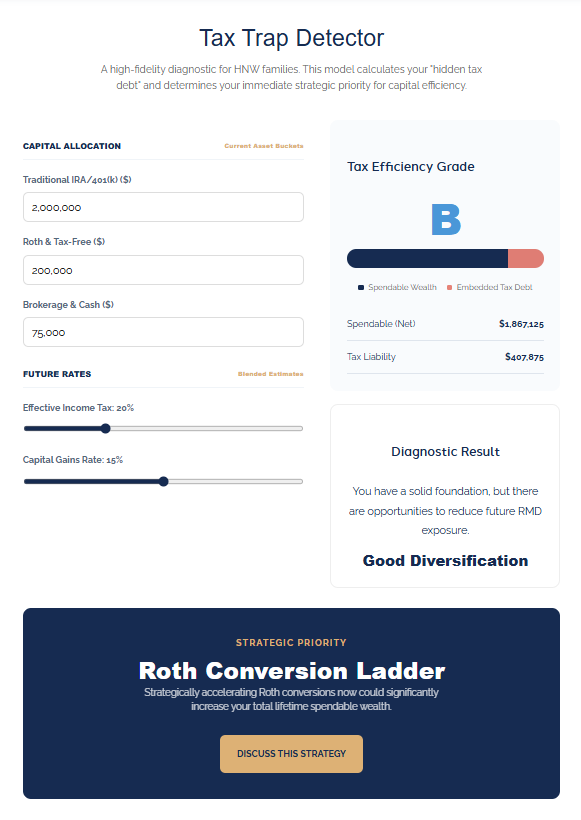
Check Your Grade: I have built a diagnostic tool to help you see exactly how much of your wealth is actually spendable versus how much is tax debt.
Ready to take action? Use your Financial Freedom Checklist to start the process:
Step 1: Complete Section 02 by categorizing every account you own into one of the three buckets.
Step 2: Identify "Strays." These are old 401(k)s from previous employers that might be sitting in the wrong type of account.
Step 3: Review your beneficiaries in Section 04 to ensure your most tax-efficient assets are heading to the people you care about most.
A few strategic moves today could mean hundreds of thousands of dollars in extra spendable wealth during retirement. Let's look at your results together.

Logan Foster | Financial Planner
Murray, KY
